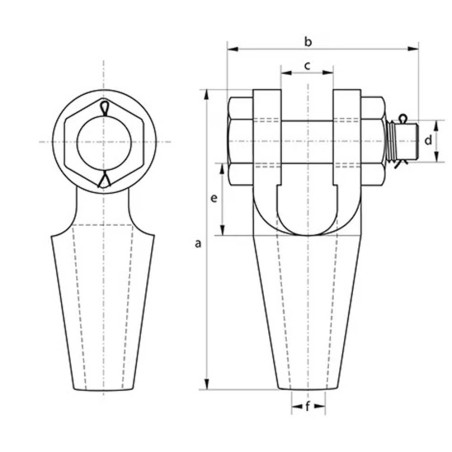
Wire rope socketing is a technical process used to create a permanent termination by securing the end of a steel wire rope inside a spelter socket. This connection must be capable of transmitting high tensile loads without the wire rope slipping or suffering an abnormal reduction in its mechanical performance.

Based in the Provence-Alpes-Côte d’Azur region of Southern France, Deal Levage carries out steel wire rope socketing in its own workshop using Green Pin open and closed spelter sockets. As an authorised Green Pin® distributor, we provide professionals with a complete service including assessment of the application, supply of the wire rope and socket, preparation of the termination, resin socketing and inspection of the finished assembly.

Our service is intended in particular for lifting and handling companies, crane and winch operators, industrial businesses, construction professionals, port and maritime operators, as well as companies working with equipment requiring a particularly strong and reliable wire rope termination.

A Workshop Specialising in Wire Rope Socketing

Wire rope socketing involves far more than simply inserting a wire rope into a socket and filling it with resin. The strength of the termination depends directly on the quality of the wire rope preparation, the uniform opening of the strands, the cleaning of the individual wires, the correct positioning of the socket and the proper penetration of the resin throughout the assembly.

An error during any of these stages can result in uneven load distribution between the wire rope wires. It may also lead to voids within the resin, prevent the resin cone from seating correctly inside the socket or reduce the overall strength of the termination when subjected to load.

For this reason, the operation should only be carried out by a workshop experienced in the preparation and socketing of lifting wire ropes. At Deal Levage, every assembly is engineered according to the wire rope diameter and construction, the type of spelter socket, the equipment on which it will be installed and its actual operating conditions.

We can supply a complete assembly ready for installation, including the steel wire rope, one or more Green Pin spelter sockets and any required connecting accessories. This approach ensures dimensional compatibility between all components while reducing the risk of incorrect selection between the wire rope, the socket and the attachment point of the equipment.

What Is Wire Rope Socketing?

Wire rope socketing is a termination method used to permanently secure the end of a steel wire rope inside a tapered steel spelter socket. It creates a strong connection point that can be attached to a shackle, pin, hook block, drum, crane mechanism or any other component of a lifting system.

During the preparation process, the strands of the wire rope are opened and the individual wires are spread evenly to form a symmetrical broom. This operation is commonly referred to as brooming. The prepared end is then positioned inside the tapered socket before being secured with a specially formulated socketing resin.

Once cured, the resin forms a solid cone around the individual wires. When the assembly is subjected to tensile load, this cone is drawn into the tapered section of the socket. The tapered geometry converts part of the tensile force into radial pressure acting against both the wire rope wires and the inner wall of the socket.

Wire rope socketing is widely used whenever the termination must withstand high tensile loads or where a compact and highly reliable connection is required. It is commonly found on crane ropes, winch ropes, lifting equipment, port handling systems, industrial installations and applications in the marine, offshore and energy sectors.

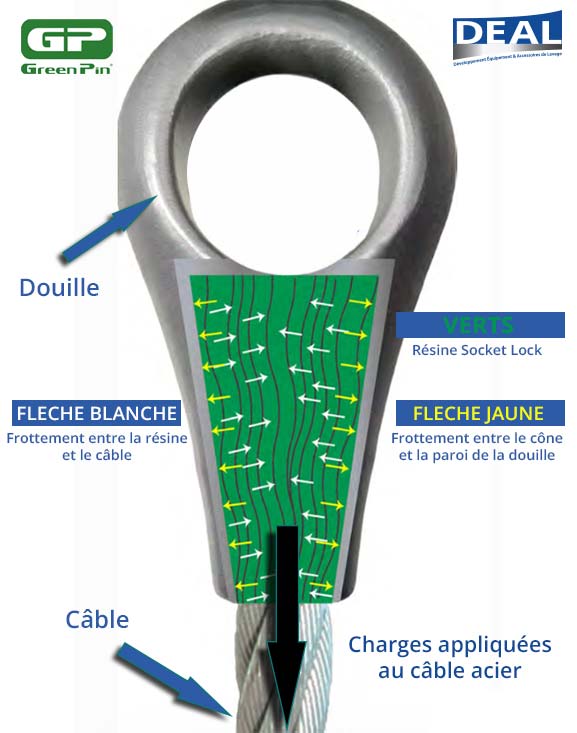
Source Green Pin
Source Green Pin

The Wire Rope Socketing Process in Our Workshop

Assessing the Wire Rope and Its Application

Before any assembly is carried out, we identify the characteristics of both the wire rope and the equipment on which it will be installed. The nominal diameter alone is not sufficient to select the correct termination. The wire rope construction, lay direction, mechanical grade, core type, operating environment and connection geometry must also be taken into account.

This assessment enables us to determine the appropriate Green Pin spelter socket model and size. It also allows us to select either an open or a closed spelter socket according to the way the termination will be connected to the equipment.

Cutting and Preparing the Wire Rope End

The wire rope is cut using appropriate procedures to preserve its construction and prevent the strands from unlaying. The end to be socketed is then prepared over a length corresponding to the selected socket.

The strands are progressively opened and the individual wires are evenly spread to form a symmetrical broom. This stage is critical to the final strength of the termination. Insufficient brooming may prevent the resin from penetrating properly between the wires, while uneven preparation can result in an unbalanced load distribution across the wire rope.

Cleaning the Wire Rope Wires

Steel wire ropes are generally lubricated to minimise wear and protect against corrosion during service. While this lubrication is essential for the performance of the rope, it must be properly managed within the socketing area.

The opened wires are therefore prepared and cleaned to ensure optimum resin penetration and to prevent excessive lubricant from creating an unfavourable interface between the wires and the socketing compound. This operation must be carried out without damaging the wires or altering their mechanical properties.

Preparing the Spelter Socket

Before assembly, the socket is carefully inspected to verify its reference, dimensions, overall condition and compatibility with the selected wire rope. The internal cavity must be clean and prepared in accordance with the recommendations applicable to both the type of socket and the socketing resin being used.

Particular attention is paid to the internal geometry of the socket. Depending on the design, the cavity may include grooves or other features that must be prepared in accordance with the resin manufacturer's instructions. Once cured, the resin cone must be able to seat correctly inside the socket to ensure efficient load transfer throughout the termination.

Positioning and Aligning the Wire Rope

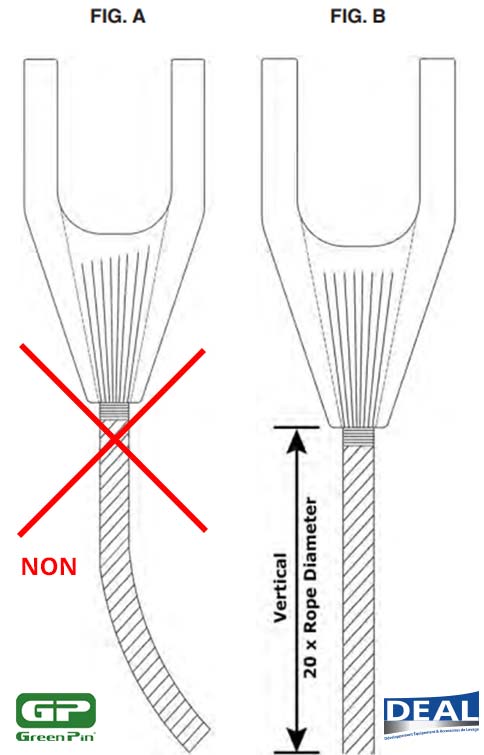
Once the spelter socket has been positioned, the wire rope is aligned with its centreline. Proper alignment is essential to ensure an even distribution of loads between the individual wires.

If the wire rope is bent or misaligned while the resin is curing, the wires become locked in an incorrect position. When the rope is subsequently straightened and subjected to load, some wires may carry a greater tensile load while others experience lower tension or even compression. This uneven load distribution can reduce the overall performance and reliability of the termination.

Maintaining the correct alignment of the complete assembly throughout the preparation, resin pouring and curing stages is therefore an integral part of the workshop's expertise. The objective is not simply to produce a visually straight termination, but to ensure proper mechanical alignment between the wire rope and the spelter socket.

Mixing and Pouring the Socketing Resin

The socketing resin and hardener are prepared in accordance with the manufacturer's specified mixing ratio and procedure. The components must be thoroughly mixed to ensure uniform curing throughout the entire volume of the socket.

The resin is then poured gradually so that it reaches the bottom of the spelter socket and fully penetrates between the individual wires. The pouring process must minimise air entrapment, as internal voids may interrupt the continuity of the resin cone and reduce the efficiency of load transfer.

The resin's viscosity, the temperature of the components and the available working time before gelation must all be carefully controlled. Resin that is too cold may flow poorly and cure more slowly, whereas excessive temperatures accelerate the chemical reaction and reduce the time available to complete the filling process correctly.

Curing and Final Inspection

After pouring, the complete assembly is kept perfectly stationary for the time required to allow the resin to gel and fully cure. The termination must not be handled or put into service until the manufacturer's recommended curing time has elapsed for the prevailing ambient temperature.

Once curing is complete, the quality of the resin filling, the alignment of the wire rope and the overall condition of the spelter socket are carefully inspected. For closed spelter sockets, the pin, nut and retaining pin are also checked before the completed assembly is released for use.

Open or Closed Spelter Socket?

The choice of termination primarily depends on the mechanical configuration of the equipment. Although both socket types use the same wire rope socketing principle, their upper sections are designed to provide different connection methods.

New
Category: Wire Rope Accessories

G-6411 Green Pin® Closed Spelter Socket

€63.60

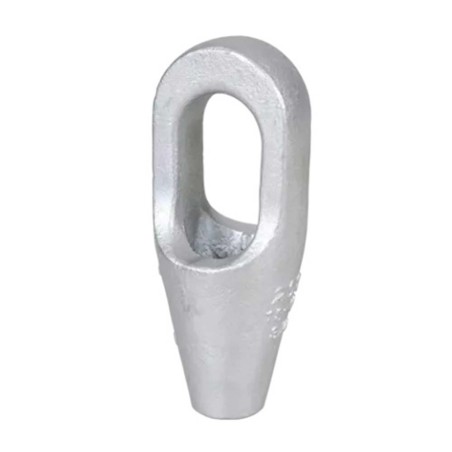
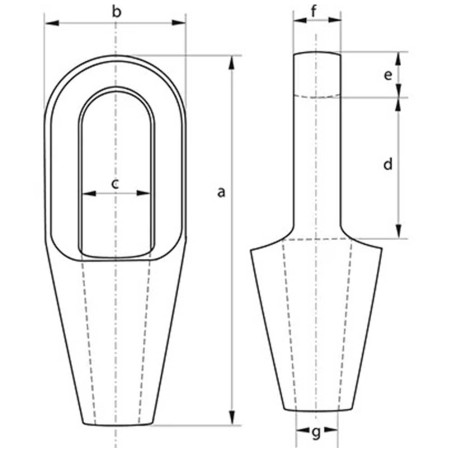
The Green Pin G-6411 Open Spelter Socket features an integral closed eye forged as part of the socket body. This eye provides a secure connection point for a shackle or any other compatible lifting accessory.

This design is particularly suitable where the termination must provide a permanent, robust and compact connection. However, the connecting accessory must be selected according to the eye dimensions, its internal opening and the loads applied to the complete assembly.

New
Category: Wire Rope Accessories

Green Pin Open Spelter Socket BN G-6422

€71.00

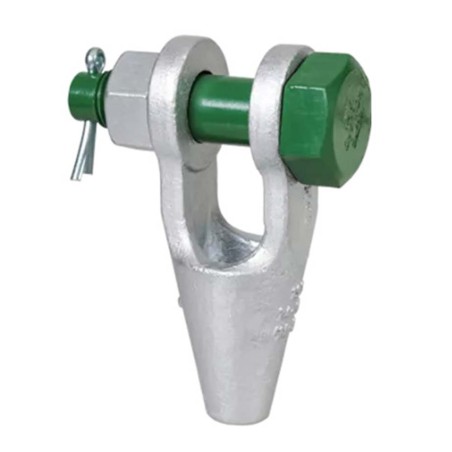
The Green Pin G-6422 Closed Spelter Socket is fitted with a detachable clevis, a bolted pin and a split pin for secure retention. This configuration allows direct connection to an anchor point, lug or any other compatible mechanical component.

The clevis design makes it possible to disconnect the assembly without affecting the wire rope socketing. It is particularly suitable for applications requiring an articulated connection or where the wire rope must be disconnected from the equipment during maintenance operations.

Why Choose Deal Levage for Your Wire Rope Socketing?

By choosing Deal Levage, you benefit from a complete service that combines the supply of high-quality components with professional wire rope socketing. We can select the appropriate steel wire rope, Green Pin spelter socket and any required connecting accessories before manufacturing the complete wire rope termination in our workshop.

Our expertise in Green Pin products and wire rope accessories enables us to verify the compatibility of every component before production begins. This is particularly important for closed spelter socket assemblies, where the socket pin must be correctly matched to the thickness and hole diameter of the attachment point to ensure a safe and reliable connection.

Whether you require a single assembly, a bespoke wire rope termination or a small production batch for maintenance purposes, we can provide a solution tailored to your application. Every project begins with a technical review to accurately define your requirements and avoid selecting components based solely on the nominal wire rope diameter.

Our objective is to supply professionals with a fully compatible, expertly manufactured wire rope termination that is ready for installation while ensuring complete traceability of the components used throughout the manufacturing process.